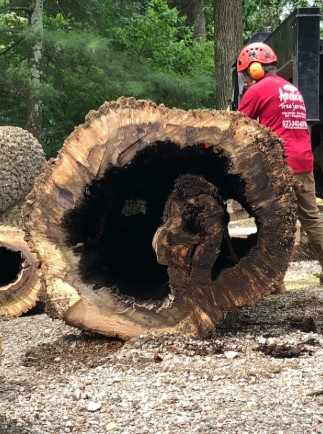
Ignoring a decaying trunk in your front garden is essentially the same as leaving a ticking financial liability unchecked. Statistical analysis of residential insurance claims clearly demonstrates that falling branches and collapsed trunks account for millions in property damage every single year. When a property owner chooses to ignore a clearly dying plant, they inadvertently accept a massive amount of unnecessary financial risk. Insurance providers categorise these specific incidents based on the concept of negligence, heavily penalising those who fail to maintain their grounds. If an adjuster determines that a homeowner reasonably should have known about the decay but failed to act, the resulting claim for a crushed roof or a destroyed garage may be entirely denied, leaving the homeowner to cover the massive rebuilding costs completely out of pocket.
The depreciation of property value is another measurable consequence of retaining diseased timber. Real estate appraisers are trained to spot visual indicators of deferred maintenance, and a dead, leafless giant towering over a home is a massive red flag that negatively affects the final valuation. Prospective buyers instantly calculate the expected cost of removal and subtract that figure directly from their initial offer, often inflating the estimated cost to account for the inconvenience. Furthermore, the aesthetic degradation caused by a rotting stump or a barren canopy heavily impacts the overall kerb appeal of the neighbourhood, driving down comparative market values for surrounding houses. Homes situated on properties with well-maintained, healthy foliage consistently sell for significantly higher margins and spend far less time on the market than those burdened by neglected, hazardous growth.
Liability extends far beyond the borders of your own property line, creating complicated legal situations for homeowners. If a weakened branch from your garden falls and damages a neighbour’s vehicle, you are entirely responsible for covering the repair costs and potentially dealing with civil litigation. In situations where heavy timber falls across a public roadway or pulls down shared utility lines, the municipality may fine the homeowner heavily while also charging them for the municipal emergency cleanup efforts. The mathematical probability of a structural failure increases exponentially with every passing month that a dead trunk is left standing upright. The internal wood dries out, becomes brittle, and loses all natural flexibility, making it highly susceptible to snapping during high winds, heavy rainfall, or sudden drops in temperature.
To mitigate these severe financial risks, homeowners must rely on a specialised tree service removal company to safely extract the liability from their grounds. These highly trained crews use precise mathematical calculations to determine exactly how a heavy piece of timber will fall once detached from the main structure. They employ advanced rigging techniques, tension lines, and commercial-grade machinery to lower massive sections of wood carefully to the ground without impacting the surrounding soil. Attempting to manage this complex logistical puzzle without the correct equipment frequently results in the exact type of catastrophic property damage the homeowner was originally trying to prevent. The cost of renting inadequate equipment and repairing DIY mistakes far outweighs the price of professional intervention.
Investing in preventative extraction is a highly calculated financial decision that protects your broader wealth and secures your largest asset. The upfront cost of hiring a professional crew is statistically insignificant compared to the potential financial ruin of an uninsured liability claim or a severe personal injury lawsuit. Maintaining a safe perimeter around your home ensures that your insurance policies remain valid and your property value continues to appreciate steadily over time without sudden drops. Careful risk management requires action rather than hesitation, especially when the potential for sudden, heavy destruction is looming right outside your front door and directly threatening your financial stability.
Conclusion
The presence of dead or dying timber on your property is a quantifiable financial risk that demands immediate attention. Understanding the severe implications for your property value and personal liability should prompt swift and decisive action. Removing these hazards professionally guarantees your financial protection and preserves the long-term aesthetic value of your home.
Call to Action
Stop gambling with your property value and secure your home against unpredictable structural failures today. Reach out to our dedicated professionals to completely eliminate the hazardous liabilities looming in your garden.
Visit: https://atreeservicenj.com/
Write a comment ...